


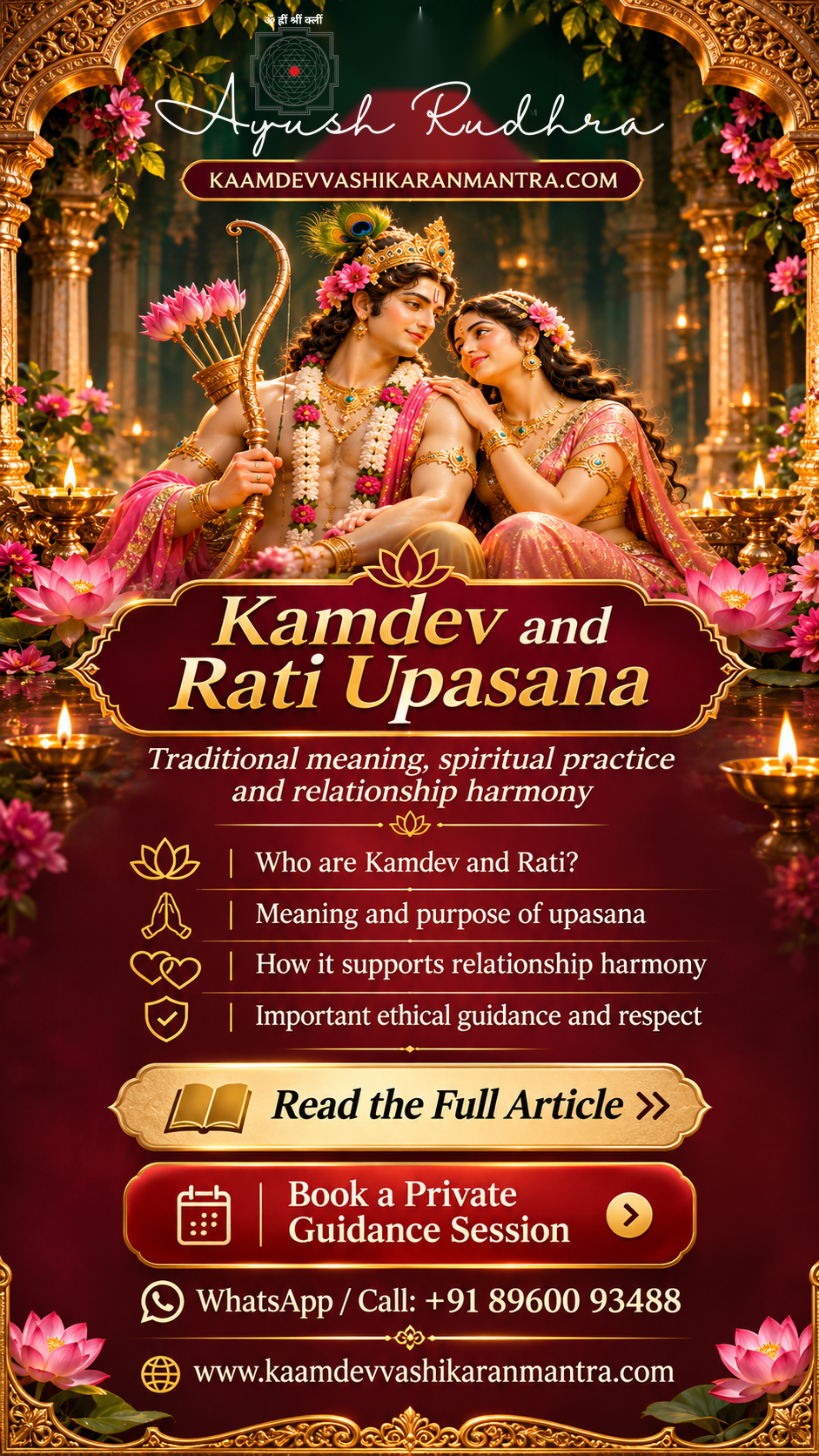
Love is often described as an emotion, yet Hindu religious and artistic traditions have also explored it as desire, creativity, companionship, longing and the responsibility that comes with human relationships. Two important figures in this tradition are Lord Kamdev (Kamadeva) and Goddess Rati. Their stories invite questions that go beyond attraction: What is the place of desire in a meaningful life? Can affection exist without respect? How should spiritual practice influence our conduct toward another person?
People searching for Kamdev Rati Upasana may be curious about traditional worship, mantra discipline, married-life harmony or a difficult emotional situation. Some arrive because they have heard claims that a ritual can make someone love them. It is important to separate devotional tradition from exaggerated marketing. Upasana is a spiritual practice, not a demonstrated method of controlling another person’s feelings or decisions.
This guide explains the symbolism of Kamdev and Rati, the devotional ideas associated with their worship, the difference between ordinary prayer and specialized sadhana, and a responsible approach to relationship concerns.
Who are Lord Kamdev and Goddess Rati?
Kamdev, also called Kamadeva, Manmatha or Madana in different traditions, is associated with love and desire in Hindu mythology. He is often depicted with a bow and flower-tipped arrows. The imagery suggests the subtle power of attraction: a feeling can change the way someone sees the world without the force of an ordinary weapon.
Rati is closely associated with Kamdev and is commonly understood as a personification of pleasure, affection and romantic experience. Their association appears in storytelling, temple imagery and historical art. The Metropolitan Museum of Art’s description of Kamadeva identifies the bow, arrows and lovebirds as important visual attributes. A Seattle Art Museum account of Kamadeva also places the deity within a broader reflection on human desire.
These representations are religious and cultural expressions. They tell us how artists and devotees have interpreted love across time; they do not prove that prayer can alter another person’s free will. Understanding that difference makes it possible to appreciate the tradition without turning it into a promise of supernatural control.
What does Kamdev Rati Upasana mean?
The Sanskrit word upasana is commonly used for devotional attention or worship directed toward a chosen deity or spiritual ideal. Practices vary by family custom, regional tradition, teacher and lineage. Some may involve simple remembrance or prayer. Others belong to specialized systems of mantra, visualization or ritual observance that traditionally require instruction.
In the context of Kamdev and Rati, a devotee may approach the symbolism as a reminder of affection, appropriate desire, marital companionship and self-discipline. This is quite different from believing that a stranger, former partner or unwilling person can be made to enter a relationship through a formula.
The most constructive question is not “How do I control the person I want?” but “How can I become more truthful, patient, respectful and responsible in the way I approach love?” That interpretation leaves room for devotion while acknowledging the autonomy of everyone involved.
Desire and responsibility: the deeper lesson of Kamdev symbolism
Desire is part of ordinary human life. People desire companionship, security, beauty, achievement and belonging. Hindu philosophical discussions often distinguish desire that exists within ethical responsibility from craving that produces harm or attachment without restraint. The stories and iconography of Kamdev offer a way to reflect on that difference.
The flower arrow is a memorable example. Attraction may begin suddenly and feel powerful, but the feeling alone does not establish a relationship. Love develops through conversation, reliability, mutual interest and shared choices. An arrow can symbolize a moment of longing; it cannot symbolize permission to disregard someone’s answer.
Rati adds another dimension to this reflection. Pleasure and affection are not meaningless; they can be part of a joyful and caring bond. Yet intimacy depends on trust and consent. A person’s spiritual wish for harmony must be matched by conduct that makes harmony possible.
The Kamdev and Shiva story: why restraint matters
One well-known strand of Hindu mythology describes Kamdev attempting to disturb Shiva’s deep meditation. Accounts vary across texts and retellings, but the broad theme includes the tension between desire and spiritual concentration. Kamdev is overcome by Shiva’s power, and traditions later develop the story of desire’s continued presence and significance.
It is useful to approach such stories as sacred narrative and symbolic teaching, not as an instruction manual for a modern relationship. One interpretation is that desire has energy but needs discernment. Strong attraction is not, by itself, a moral failure. What matters is what a person does with it: whether they cultivate patience, uphold promises and respect boundaries.
The legend also reminds us that spiritual life is not necessarily about obtaining everything we want. Sometimes practice asks us to examine a desire more carefully, accept uncertainty or recognize when an attachment is causing suffering.
Kamdev Rati Upasana and relationship harmony
Why do people associate this form of devotion with relationship harmony? In traditional devotional language, Kamdev and Rati represent aspects of attraction and companionship. People may pray for emotional understanding, warmth, patience or a more compassionate attitude within an existing relationship.
Those intentions are different from guarantees. A married couple experiencing repeated disagreements might choose prayer alongside a direct discussion about responsibilities. Someone facing rejection might use meditation to steady their thoughts while accepting the other person’s decision. A person preparing for marriage might reflect on their expectations and capacity for commitment.
None of these approaches requires claiming that a mantra causes a partner to apologize, return, marry or become emotionally dependent. Better relationships are developed through mutual effort. When only one person wishes to continue, spiritual reflection may help that person reach acceptance, but it should not become a campaign to overturn someone else’s refusal.
A respectful approach to simple devotional practice
For someone who follows a devotional tradition, a modest and voluntary personal practice may be more appropriate than attempting an elaborate ritual learned from a social-media post. The details of worship differ across traditions, so there is no single universal sequence that every seeker must follow.
Begin with a clear and ethical intention
Instead of asking that a named person be compelled to behave in a particular way, frame your intention around wisdom, emotional steadiness, kindness and mutual harmony. If you are in a relationship, seek understanding that benefits both partners. If you are single, focus on readiness for a relationship in which interest is freely shared.
Make room for quiet reflection
A simple period of prayer, respectful remembrance or silent meditation can give structure to the day. Choose a safe, quiet place where you are comfortable. You do not need to make grand promises, isolate yourself or spend money on unusual objects to reflect sincerely on your conduct.
Treat mantras with traditional care
Mantra pronunciation, discipline, initiation requirements and ritual context may differ among lineages. It is unwise to present one internet formula as universally correct for every devotee. If you are seeking a specific practice, ask a knowledgeable and responsible teacher about the method, its purpose and any traditional restrictions. Do not improvise advanced practices involving fasting, substances, fire or other potentially unsafe activities.
Connect devotion with everyday behaviour
Notice how you communicate when upset. Can you apologize without demanding immediate forgiveness? Can you hear a partner’s concerns without threatening to leave? Can you accept rejection without monitoring or pressuring someone? Acts of listening, respect and self-control are concrete ways of honoring the values you associate with affectionate companionship.
Keep expectations realistic
You may find prayer personally meaningful, calming or spiritually fulfilling. But there is no reliable evidence that it can change another person’s emotions from a distance, cure relationship conflict by itself or guarantee marriage. Do not measure the worth of your practice by whether someone sends a message the next morning.
Is Kamdev Rati Upasana the same as vashikaran?
These terms appear together frequently in online searches, but they should not be treated as interchangeable. Kamdev and Rati are religious figures associated with desire and affection. Upasana refers broadly to devotional practice. Vashikaran is a term used in various popular and esoteric contexts, often promoted online with exaggerated claims of influence or control.
Some websites portray vashikaran as a guaranteed way to make a chosen person fall in love or return after separation. Such claims should be viewed critically. Relationships involve the independent choices of two people, and no credible practitioner can verify another person’s consent through a ritual. A person who has declined contact must not be pursued in the name of spiritual practice.
On this website, the About Guru Ji Ayush Rudhra page describes an approach emphasizing personal responsibility, spiritual discipline and avoidance of forced-control promises. For questions about the terminology and personal circumstances, start with the private consultation process, not the assumption that any specialized ritual is automatically suitable.
Why internet mantra instructions can be misleading
Search results sometimes present a short Sanskrit line followed by a fixed repetition count, a promise of rapid attraction and a request to purchase an additional remedy. These instructions may leave out crucial context: different traditional sources, correct pronunciation, teacher guidance, personal suitability and, most importantly, ethical limits.
A repetition count is not a measurable guarantee. A beautiful mantra can be meaningful to a devotee without becoming a tool for controlling a person who does not reciprocate their feelings. Be cautious if a page says that refusing a paid ritual will produce a curse, that an ex-partner must return within days or that results can be guaranteed without understanding the situation.
Readers may also find our older Kamdev mantra introduction. Its attraction-oriented framing should be read with the important qualification explained here: no mantra overrides consent or guarantees romantic results. The present article is focused on the broader traditional meaning of Kamdev and Rati rather than a promise about any desired individual.
When spiritual questions overlap with real relationship problems
A person considering Kamdev Rati Upasana may be carrying a private difficulty: repeated arguments with a spouse, family opposition to marriage, emotional distance, a painful breakup or uncertainty about whether feelings are mutual. The first step is to describe the situation accurately.
Ask what the other person has actually communicated. Is the issue a misunderstanding that both are willing to discuss, or has the person clearly said no? Is the family disagreement about finances, values or safety? Are there patterns of humiliation, threats or surveillance that need practical intervention? These questions are not less spiritual because they are concrete. They are necessary for responsible decisions.
Where both partners want to repair a relationship, listening and counselling may help. Where a relationship has ended, support from trusted people or a qualified professional may assist with grief and recovery. If there is abuse, coercion, stalking or threats, prioritize safety and professional assistance. A spiritual consultation should never delay appropriate legal, medical or mental-health support.
How Tantrik Ayush Rudhra Ji approaches private guidance
Guru Ji Ayush Rudhra Ji’s website presents consultation as an individual, appointment-based process rather than an automatic recommendation for a mantra, puja or anushthan. The starting point is a factual account of the concern, followed by an explanation of the available consultation scope and possible next steps. Whether any traditional practice is suitable is considered only after the case has been discussed.
If you want to ask about the tradition itself, you can prepare questions about the symbolism of Kamdev and Rati, the difference between basic devotion and specialized sadhana, or whether a particular family practice has an established context. If your concern involves a relationship, explain the actual situation without presenting unverified suspicions as facts.
You can review the official consulting page to understand appointment preparation, the process and realistic expectations. Check current fees, format and availability through the official booking route; no ritual or financial commitment should be assumed in advance.
What should you ask before accepting a spiritual service?
A responsible advisor should be willing to explain whether they are providing education, a personal consultation or a separately agreed spiritual service. Ask what the consultation covers, what details are genuinely needed and whether anything additional is optional. Ask for clear information about pricing and payment before proceeding.
Be particularly careful when someone requests intimate photographs, account passwords or another person’s private messages. Do not share unnecessary personal information to demonstrate devotion. Reject services built around threats, revenge, humiliation or secret surveillance. Spiritual seriousness should appear in transparent conduct and respect for boundaries, not in frightening claims.
It is also reasonable to ask how a practitioner handles uncertainty. A trustworthy answer may include “I cannot know that from the information provided” or “This may not be appropriate.” A professional who never acknowledges limitations may be offering confidence rather than clarity.
Frequently asked questions
Who are Kamdev and Rati in Hindu tradition?
Kamdev is commonly associated with love and desire, while Rati is associated with pleasure and affectionate experience. Their imagery and stories appear in Hindu religious and artistic traditions, with details varying by text and region.
What is the purpose of Kamdev Rati Upasana?
People may approach the practice as devotion associated with affection, emotional harmony or reflection on desire. Its meaning depends on the spiritual tradition followed. It should not be represented as a guaranteed way to control another person’s decision.
Can Kamdev Rati Upasana bring an ex-partner back?
There is no reliable evidence that prayer or ritual can compel an ex-partner to return. If both people want to reconnect, honest communication may be possible. If the other person has refused contact, that boundary must be respected.
Do I need initiation for Kamdev Rati sadhana?
Requirements differ across traditions. Simple personal prayer is not the same as specialized ritual or mantra sadhana. Seek guidance from a knowledgeable teacher before beginning any demanding or restricted practice.
Is there one correct Kamdev Rati mantra for everyone?
Not necessarily. Mantras and ritual details vary by text and lineage. Avoid assuming that an isolated online mantra or repetition count is universally authoritative or guarantees any result.
Can a married couple pray for better understanding?
A couple may choose prayer as part of their shared faith and reflection. Its practical value is best supported by respectful communication, attention to shared responsibilities and a willingness to resolve conflict together.
Is vashikaran a way to force someone to love me?
No service should promise or attempt to override another person’s free will. Online claims of guaranteed control deserve skepticism, and unwanted pursuit or harassment should never be justified by spiritual language.
How can I learn whether a spiritual practice is appropriate for my situation?
Start with an honest description of your concern and ask about the practice’s tradition, ethical boundaries and risks. The official consultation page explains how to seek private guidance without assuming a ritual will be recommended.
Is Kamdev Rati Upasana a replacement for relationship counselling?
No. Devotion may have personal meaning, but it does not replace therapy, counselling, safety planning or legal help when those are needed. It also cannot establish whether someone else wishes to continue a relationship.
A more meaningful way to approach love and devotion
Kamdev and Rati remain compelling figures because they give language and imagery to an important part of human experience. Desire can inspire creativity and closeness, but it also needs patience, honesty and restraint. Devotion becomes more meaningful when it encourages those qualities instead of promising power over another person’s emotions.
Have a personal question about Kamdev Rati Upasana, relationship harmony or traditional spiritual guidance? Read the official consultation process and, if appropriate, arrange a private discussion with Guru Ji Ayush Rudhra Ji. Every situation should be understood individually. There is no guaranteed reconciliation, forced attraction or automatic recommendation for a paid ritual.
