


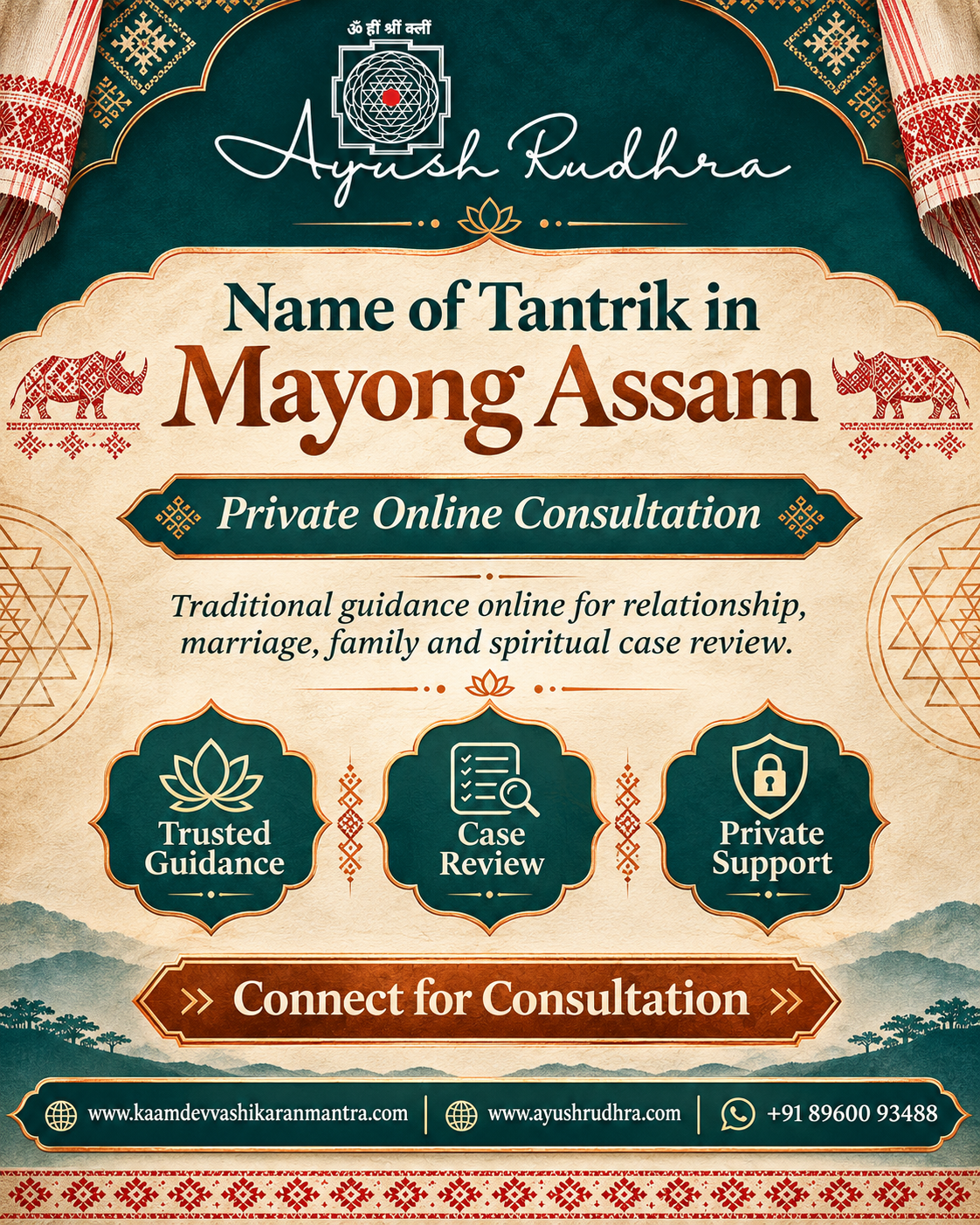
If you type name of tantrik in Mayong Assam into a search engine, you may see numerous profiles, old blog posts and assertions about famous or powerful practitioners. A name is a useful starting point, but it does not tell you whether someone is trained, currently available, correctly represented online or suited to the question you have. This guide focuses on a verifiable name from the supplied official network: Tantrik Ayush Rudhra Ji, whose public profile and contact details appear on KaamdevVashikaranMantra.com and AyushRudhra.com.
This is not a complete directory of all Tantrik practitioners in Mayong. It would be misleading to suggest there is only one, or that a private promotional website provides an independently audited ranking. Instead, we explain the cultural setting, what to look for in a public profile, and how to verify a specific practitioner before an appointment.
Mayong, Assam: more than an internet label
Mayong, also written Mayang, is a locality in Assam commonly associated in popular accounts with mantra, Tantra, folklore and older healing traditions. Visitors encounter stories about manuscripts, oral knowledge and the region’s esoteric reputation. Such stories form part of a living cultural imagination, but individual legends should not be presented as proof that every advertised ritual or supernatural claim works.
The location matters because it helps distinguish an actual regional tradition from a generic advertisement that inserts “Mayong” into every city keyword. It is reasonable to ask where a practitioner learned, which spiritual lineage they publicly describe, and how they understand the relationship between folk traditions, devotional practice and Jyotish. You do not need to accept an extraordinary claim merely because it is associated with a historic place.
A publicly listed practitioner: Tantrik Ayush Rudhra Ji
The official about page identifies Ayush Rudhra Ji and describes his interest in psychic astrology, Mayong-related traditions, Kamakhya-oriented worship and individual consultation. The account includes a stated guru and spiritual journey. Those are the website’s own biographical claims; readers can evaluate them alongside independently available references rather than treating every statement as external verification.
For current enquiries, the primary contact page lists +91 89600 93488. The Mayong contact resource on the secondary site also identifies the published official route. Verify the number anew before paying or sending private details.
No page can make a person universally “the most powerful.” The relevant question is whether the publicly described practice aligns with the matter you want to discuss and whether the process is understandable, respectful and safe.
What does a Tantrik do in different Indian traditions?
There is no single job description covering every person called a Tantrik. Tantra is used across different religious, historical and regional contexts. Some practices emphasise worship, mantra repetition, ritual symbolism and spiritual discipline; others are interpreted through particular lineages or local customs. A practitioner who offers private astrology consultations is not the same as a temple official, a physician, a mental-health professional or a legal adviser.
Online marketing often narrows the word to love spells, black magic and guaranteed intervention. That presentation is too simplistic. If you are interested in mantra japa, devotional observances or horoscope interpretation, ask for a clear explanation of what is being offered. An ethical consultation should not claim that another person’s consent can be removed, or that payment will automatically change a court decision, illness or employer’s action.
Mayong versus Kamakhya: why the distinction matters
The terms are often placed next to each other in search results, yet they are not geographic synonyms. Mayong is associated with the Morigaon region, while Kamakhya is prominently linked with a Shakti Peetha in Guwahati. A practitioner might discuss experiences with both, but a private profile does not thereby become an official representative of Kamakhya Temple.
When researching Mayong Assam tantrik name or Kamakhya famous Tantrik, distinguish an individual’s claimed training from a temple’s administration, a village’s heritage and a commercial consultation. The existing Kamakhya profile page can provide the primary site’s perspective, while independent travel or temple information should come from appropriate authorities.
Evaluate names through evidence, not superlatives
Start with a full name, an official website, a consistent contact route and a description of the appointment process. Check whether multiple pages on the same site agree about basic identity. Examine publication dates when claims are time-sensitive. Published interviews or media mentions can help confirm that a person has a public presence, but they do not scientifically establish the effectiveness of spiritual services.
Be skeptical of unverifiable “number one,” “100% guarantee,” “world’s most powerful” or “love back in 24 hours” language. Ask how the practitioner handles privacy, payment, cancellation, consent and unexpected outcomes. A respectful response should never intimidate you for asking.
A practical comparison table for your own research may include: practitioner name; official domain; verified phone; stated tradition; service category; consultation mode; stated fee; written booking confirmation; refund/cancellation information; and warning signs. Keep factual observations separate from impressions or endorsements.
Match the practitioner to the concern
Someone seeking a relationship discussion may want help clarifying a difficult conversation, understanding family pressure or exploring a culturally meaningful horoscope interpretation. Someone concerned about repeated household conflict may need practical mediation or professional counseling. Someone who fears black magic may need reassurance, medical attention for symptoms, or support for anxiety before discussing any optional devotional practice.
A practitioner should not interpret every issue as spiritual interference. Job loss, business disputes, financial difficulties and marriage conflicts frequently have ordinary causes. Spiritual support can coexist with practical action, but it cannot replace it. For a relationship-specific explanation, the secondary site’s relationship page is more relevant than a generic “famous Tantrik” headline.
An example of a useful first consultation request
Suppose a person from Kolkata is searching for a Mayong practitioner because a proposed love marriage has stalled. Rather than sending the entire family history to a random number, they could write: “I would like a private consultation about marriage delay and disagreement between both families. Please confirm the official plan, timing, language and whether birth details are needed.” This is enough to ask whether the service fits.
Someone researching traditional mantra practice might ask: “Does this consultation explain the devotional context and safe daily routine? Is any ritual optional?” A business owner could ask whether the session is limited to spiritual reflection, rather than mistaking it for certified business advice. The quality of the question often improves the quality of the conversation.
Reading old articles without confusing them with current booking instructions
The web contains older Mayong articles that mention several contact numbers and dramatically worded claims. Historical text may still rank prominently after a website updates its booking process. Treat dated content as background, not as final confirmation of today’s phone, availability or payment instructions.
The primary site’s Mayong profile and dedicated Mayong guide are relevant starting points, but the active contact and booking pages are more appropriate for transactions. Do not respond to a WhatsApp profile claiming to be an assistant unless it matches an official route.
How to read a spiritual biography critically and respectfully
Practitioner profiles often describe a personal journey, guru associations, places visited and preferred rituals. These may be meaningful autobiographical statements. When evaluating them, separate a claim that someone visited a location from a claim that an institution officially endorsed them. Separate the fact that an article mentions a practitioner from the conclusion that a service has a proven success rate. This approach does not disparage faith; it prevents marketing text from being mistaken for independent evidence.
A good profile answers basic questions in ordinary language: who the person is, what they offer, where the work is based, how appointments are arranged, and what limits apply. It should also make contact information easy to verify. Be cautious if the only information is a sequence of titles such as “top,” “celebrity,” “greatest” or “most powerful,” without a transparent consultation process.
Why Mayong’s folklore deserves accuracy
Mayong-related legends have attracted attention because they reflect a distinctive cultural history, yet stories and commercial assertions should not be treated as the same kind of evidence. Folklore can be discussed as folklore; private practice can be discussed as a practitioner’s self-description; contemporary consumer claims need contemporary verification. The difference helps protect Mayong from being reduced to a sensational label and helps visitors understand why people from the region may describe traditions in different ways.
A respectful visitor does not assume residents are performers of magic, ask strangers for secret rituals, or treat local religious life as a spectacle. If you are visiting for cultural interest, look for appropriate community and heritage resources. If you are contacting a practitioner, follow their official appointment route rather than treating village residents as an informal directory.
A scenario: a name found in an old video
Suppose you see a video naming a Mayong Tantrik but the description contains a phone number different from the one on their current official website. The video may be old, reposted or unauthorised. Before calling, check the upload date, search for the claimed practitioner’s official domain and compare active contact pages. Do not trust a link that asks you to install software or share an OTP to “verify identity.”
If the old video recommends a ritual that claims to control a spouse, recognise that consent cannot be bypassed. You can ask about traditional context, but you are not obliged to follow any process that feels threatening, unsafe or financially exploitative.
A better way to search for the person you need
Instead of using only “name of tantrik in Mayong Assam,” add the actual need: Mayong astrologer official contact, Tantrik in Mayong private consultation, Mayong Tantra mantra traditions, Mayong relationship guidance, or Assam Tantrik booking process. These related searches identify distinct informational intents. They should not be jammed into every paragraph of a single article; they should help the reader find the right section and official page.
If you only need to confirm a phone number, choose an active contact page. If you want a biography, choose an about page. If you want to pay for a session, use a dedicated booking page. The most useful digital journey lets the reader move between those goals without false claims or unnecessary friction.
Questions for a short verification call
A five-minute preliminary enquiry can be surprisingly informative. You might ask: “Are you the official appointment team for the practitioner named on this website?” Then confirm the exact plan and whether a session is online or in person. Ask what topics are accepted, whether birth details are necessary, what happens if the appointment cannot proceed, and how payment is verified. A genuine service may need to check availability, but should not invent a supernatural crisis in response to ordinary questions.
If you are comparing practitioners, use identical questions for each. This creates a fair comparison. Do not rank one person higher merely because they answer with more mystical language. Focus on communication, transparency and whether they respect the limits of the service. If a practitioner offers a tradition-specific devotional explanation, consider whether its assumptions are consistent with your own beliefs.
How to avoid SEO duplicate-name traps
Search engines can show several pages with near-identical titles such as “Best Tantrik in Mayong Assam” or “Famous Mayong Tantrik Contact.” The duplication may reflect affiliate marketing, old posts or sites competing for the same keyword. Look beyond headings. Are there original biographical details? Do pages point to the same verified contact route? Are claims dated? Is the service process consistent? Do copied pages use exaggerated testimonials that cannot be checked?
A good informational article should answer the name question within its opening paragraphs, then provide context, verification and next steps. It should not delay the identity behind thousands of words of general mysticism. Equally, a directory that names only one practitioner without saying it is a limited example may mislead readers into thinking it is exhaustive.
Protecting Mayong’s reputation while researching individuals
Regional identity deserves care. Mayong has its own community and cultural life, and the internet’s fascination with magic can obscure that reality. A respectful seeker can investigate spiritual tradition without treating local residents as attractions or assuming all practitioners use identical methods. If a person claims a lineage or institution, ask for a clear explanation rather than accepting broad geographical prestige as proof. An authentic connection to a place is not the same as the ability to guarantee an individual’s marriage, finances or wellbeing.
Frequently asked questions about the name of a Tantrik in Mayong
Can you name a publicly listed Tantrik connected with Mayong Assam?
Yes. Tantrik Ayush Rudhra Ji is named on the official websites linked in this guide. This is not a claim that no other practitioners exist in Mayong.
Is he officially employed by Kamakhya Temple?
The sources discussed here are private practitioner websites. Do not infer temple employment, certification or endorsement from references to Kamakhya spiritual traditions.
How can I verify the contact number?
Compare the active primary contact page and the secondary Mayong contact guide. Both publish +91 89600 93488 for consultation enquiries.
Is Mayong literally a place where every resident performs Tantra?
No. Mayong is a real community with ordinary social and economic life as well as cultural associations. A region’s folklore does not describe every resident or business.
Can a Tantrik guarantee love marriage or black magic removal?
No fixed outcome can responsibly be guaranteed. A practitioner may discuss tradition or offer voluntary spiritual support, but evidence and professional help still matter.
Are online consultations available?
The official booking pages describe remote appointments. Actual schedules, fees and formats need confirmation rather than assumption.
What should I ask before travelling to Assam?
Confirm the visit location, date, meeting approval, price and contact route privately. Never assume a historical address or temple mention guarantees a walk-in appointment.
Conclusion: a name should lead to verifiable details
The search name of tantrik in Mayong Assam is best answered with an identifiable person and an honest explanation of what is and is not known. Ayush Rudhra Ji is one publicly listed practitioner in the websites reviewed here. If you wish to make an enquiry, use the official consultation booking page and verify current contact details. Choose a practitioner through clear identity, transparent process, consent-respecting guidance and realistic boundaries—not unsupported rankings.
